

Part 2 of 3 in our series on starting and growing a small business in Australia in the age of AI. Start with Part 1: The Solopreneur Opportunity.
Before you build a big website or sign up for a monthly marketing plan, answer three questions: who will buy, what will they pay for, and can you deliver it at a profit?
This guide is for Australians starting a side hustle or small business. Product and software founders can use the same early steps, with a prototype or paid pilot in place of a service package. It is general information only. Requirements depend on your activity, structure and location, so check official guidance and get advice where you need it.
1. Set a goal and a spending limit
Decide what you want from the business. An extra $500 a month, a future replacement income and a product aimed at national growth need different plans.
Write down your available hours, how much you can afford to spend testing the idea and a date to review the evidence. Count the time for selling, admin and customer support, not just the paid work.
If you are employed, check your contract and workplace policies for rules on outside work, conflicts of interest, confidentiality and intellectual property. Keep the side business off your employer’s time, systems and information. Get advice if it is unclear.
2. Talk to the people who would buy
Choose one customer group you can actually reach. “Small businesses” is too broad. “Independent cafes within driving distance that need product photography” is a useful starting point.
Ask about their experience:
- When did this problem last happen?
- How do you deal with it now?
- What does that cost you in money or time?
- What makes it hard to change?
- Who makes the buying decision?
Listen before you pitch. Compliments, survey answers and likes are weak signals. A purchase, a paid pilot or a firm buying commitment is strong evidence. For an expensive or regulated product, a meaningful test may be a signed pilot agreement or a procurement conversation rather than an instant sale.
AI can help here: use it to draft your interview questions, summarise your notes and spot patterns across conversations. It cannot do the conversations for you.
3. Make one clear offer
Describe the customer, what they get, the scope, the price and the next step. Say what is included, what costs extra and how long it takes.
For example: “A photography session for independent cafes, including 20 edited images for menus and social media, delivered within seven days.” Set the price after checking your costs and the market.
For software, define the smallest useful task the product performs and find people willing to test that task. Watch what they do. A long feature list can hide an unclear benefit.
4. Check the numbers work
Count materials, travel, packaging, payment fees, software, subcontractors, and the time spent on revisions, support and admin.
An example for a service, with amounts excluding GST:
- Revenue per job: $300
- Direct costs per job: $60
- Your time: 4 hours at $40 an hour, so $160
- Left after costs and your time: $80
If your fixed costs are $320 a month, four jobs cover them. A fifth job adds $80 before income tax and any costs not counted. The “your time” figure is a planning tool, not a tax deduction.
This is why revenue alone can mislead. A full calendar can still pay badly.
Check cash timing too. You may pay suppliers before customers pay you. Agree sensible payment terms, ask for deposits where it suits the work, and keep a reserve. An unpaid invoice is not money in the bank.
5. Get the Australian basics right
Before you trade, take deposits or do regulated work, check what applies to your activity and location. Early customer research can usually happen first.
- Business structure. Compare sole trader, company and other structures. A company is a separate legal entity, but directors have duties and can still be personally liable. Directors need a director ID before they are appointed.
- ABN. Check your entitlement with the Australian Business Register. Applying directly through the ABR is free, so avoid paid “ABN services”. An ABN alone does not prove an activity is a business for every tax or legal purpose.
- Name and brand. Check business name rules, search existing trade marks with IP Australia and check domain availability before you invest in a brand. A registered business name does not give you the protection of a registered trade mark.
- Government fees. From 1 July 2026, registering or renewing a business name costs $47 for one year or $108 for three years. Registering a company costs $636, plus an annual review fee for a proprietary company. Check business.gov.au for current amounts.
- GST and tax. For most businesses, you must register for GST when your current or projected GST turnover reaches $75,000. That is turnover, not profit, and it is tested on current and projected turnover, not just at the end of the financial year. Taxi and ride-sourcing drivers must register from day one. Check the ATO guidance.
- Licences and insurance. Use ABLIS to find the licences and permits for your activity and location, and check with your council if you work from home. Get insurance suited to the work you actually do.
- Money and records. Keep business transactions easy to identify, keep receipts and invoices, and choose a simple bookkeeping method. Ask your accountant how much to set aside for tax.
- Customer terms. Put scope, delivery, payment, cancellations and support in writing. Your terms must respect the consumer guarantees under Australian Consumer Law. A blanket “no refunds” sign does not remove those rights.
6. Set up just enough for someone to buy
For an early service business, that might be a professional email address, a clear offer page or proposal, a way to contact you, a way to quote and get paid, and a simple enquiry tracker. A spreadsheet is fine to start.
An online store also needs accurate product details, stock and delivery arrangements, a working checkout and a returns process. A software pilot needs easy onboarding and support.
- .com.au domain. Check auDA’s rules: you need an Australian presence and a connection to the name. Register it in the business owner’s name and keep control of the login so you can renew it.
- Google Business Profile. Set one up if you are eligible, which generally means you meet customers in person. Online-only businesses are generally not eligible.
7. Find your first paying customers
Start where trust already exists. Depending on your business, that could mean introductions from your network, businesses that serve the same customers, a relevant directory, a local event, or a community group that allows promotion.
Make each approach specific and useful. Follow group rules and Australia’s spam laws: a publicly listed email address is not automatic permission to send marketing.
Record where each enquiry came from, what the person needed, whether they bought and why not. That is more useful than a follower count when you are testing an offer.
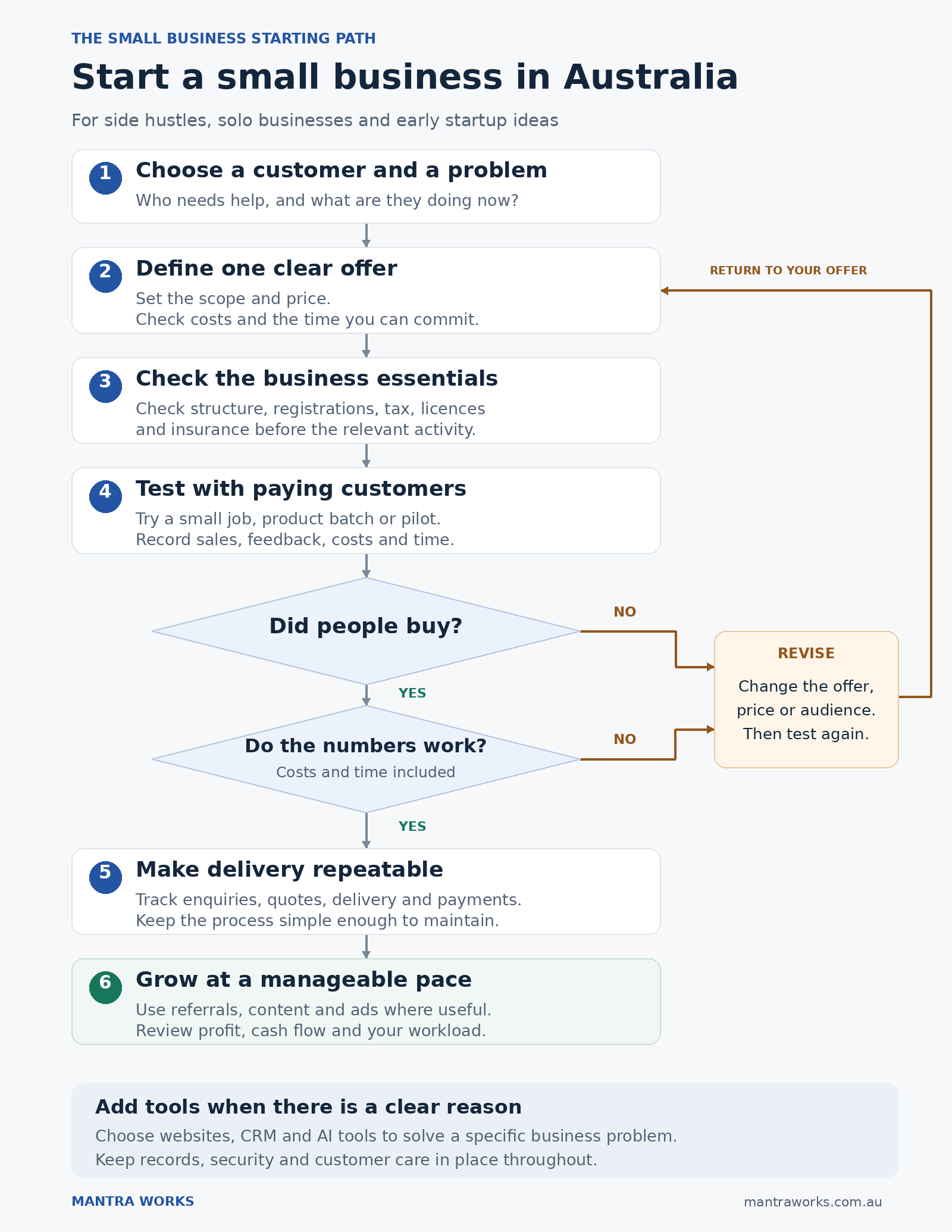
A 30-day starting plan
- Week 1: Choose one customer group, research its problem, and set your time and spending limits.
- Week 2: Shape one offer, check the numbers, and complete what you need before selling.
- Week 3: Make the offer through a few relevant channels. Aim for paid work or a real pilot commitment.
- Week 4: Deliver, collect feedback, and compare actual time and costs with your estimate. Decide to continue, change the offer or stop.
This is a review schedule, not a promise of customers within a month. Some businesses need longer for development, licensing or slow buying cycles.
Next in this series: How to Build a Small Business Growth System Without Doing Everything Yourself.
If your offer is ready and you need a simple way for customers to find you, enquire or book, Mantra Works can help you choose the setup that fits your stage. We are Australian owned and run. Get in touch.
General information only, not legal, tax or financial advice. Requirements depend on your activities, structure and location. Check current official guidance and get advice where needed.
Sources
- Becoming a company director, ASIC
- ABN entitlement, Australian Business Register
- Search existing trade marks, IP Australia; Business names, ASIC
- Changes for businesses from 1 July 2026, business.gov.au
- Registering for GST, Australian Taxation Office
- Australian Business Licence and Information Service (ABLIS)
- Consumer rights and guarantees, ACCC
- com.au domain names, auDA
- Business Profile eligibility guidelines, Google
- Avoid sending spam, ACMA